
cladding

H = healthy
Is the material safe?
C = conscious
Is the material sustainable?
D = durable
Will the material last?
Materials we actively promote.


Materials we like to use.

Materials we use.

Materials we try to avoid.

Materials we advocate against.
board, shingle, & panel
Board cladding consists of long pieces installed horizontally, vertically, or diagonally, available in a variety of profiles, widths, and finishes. Fasteners can be exposed, concealed, or utilize hidden clip systems. Materials include wood, metal, fiber cement, and vinyl. Shingle cladding is made up of smaller overlapping pieces offered in a wide range of sizes, shapes, textures, and styles in different materials. For aesthetic variation, may be installed in patterns including straight, staggered, scalloped, and diamond. Panel cladding is made from large, prefabricated sections attached to the exterior of a building with exposed or concealed fasteners. Depending on the material, these panels can be flat, corrugated, manufactured in a variety of sizes, and installed in vertical and horizontal orientations.
wood / domestic
H — Natural material, select healthy finish options to avoid installers in hailing noxious fumes, even dust from natural materials poses a health risk & should be avoided.
C — Proper sourcing will be local & sustainable, prioritize third-party certification, renewable resource, biodegradable, appropriate for a conscious home.
D — Susceptible to mold, mildew, water damage, or pest, different species require varying levels of maintenance & refinishing, not appropriate in fire-prone areas, lifespan 20 - 40+ years with proper care.
modified wood / acetylated
H — Softwood chemically treated using acetic anhydride, final produce safe & inert.
C — Modification requires proper facilities & is energy intensive, often significant embodied energy in transportation, biodegradable, use products utilizes fast-grown & renewable wood sources.
D — Molecular modification resists decay, rot, & insect damage, long-lasting, moisture-resistant, maintains strength, appropriate for a durable home, lifespan 50+ years.
modified wood / thermally modified
H — Natural product, utilizes heat & steam to increase durability without chemical additives, does not off-gas, no hazards beyond working with unmodified wood.
C — Choose products that utilize sustainably harvested & fast-growing species, energy-intensive heating process, biodegradable, no chemicals to pose a leaching concern.
D — Altered cellular composition resists insects, mold, rot & fungal decay, dimensionally stable, reduced swelling, shrinking, & warping, requires surface treatment to prevent fading, limited strength, lifespan 20 - 30 years.
metal / aluminum
H — Non-toxic, safe to install, no runoff concerns when uncoated, coatings vary in composition & health concerns, not sound absorptive.
C — Virgin material is energy-intensive to produce, smelting creates perfluorocarbons (PFCs), highly recyclable without loss of quality, often produced with a high recycled content, high solar reflectance minimizing heat absorption.
D — Lightweight, mailable, insulating with low thermal conductivity, resistant to rust & corrosion, suitable for marine environments, fireproof, soft & susceptible to denting & scratching, lifespan 30 - 50 years.

modified wood / furfurylated
H — Softwood impregnated with furfuryl alcohol (derived from agricultural waste) and then heated to polymerize the alcohol, processing releases VOCs, machining can off-gas and release odors.
C — Heating process is carbon-intensive, transportation often has significant embodied energy, doesn't leach harmful chemicals into soil or water, biodegradable.
D — Superior density to other modified woods, dimensionally stable, resists swelling, shrinking & warping, resists rot & fungal growth, moisture resistant, requires stainless steel fasteners, lifespan 30 - 40 years.
metal / steel
H — Galvanized coatings contain zinc, which can leach toxic by-products from production processing, associated health risks with cutting, welding, or grinding galvanized metal.
C — Can contribute to zinc runoff contaminating groundwater & aquatic ecosystems, exacerbated in acidic or coastal environments, energy-intensive to produce, recyclable.
D — Higher percentages of zinc yield better resistance, strong & durable, low maintenance, typically less expensive than aluminum, good option in hail-prone regions, lifespan 40 - 60 years.
fiber cement
H — Made from cement, sand, & cellulose fiber, does not emit harmful chemicals or off-gas once installed, cutting releases silica dust & poses a health concern for workers.
C — Energy-intensive manufacturing process, some brands incorporate renewable cellulose components, not biodegradable, difficult to recycle.
D — Long-lasting, heavy, non-combustible, pest-resistant, does not crack or warp easily even in harsh climates, requires periodic refinishing, lifespan 30 - 50 years.

wood / imported
H — Natural product, non-toxic with selection of healthy finishes, workers should take precautions to avoid dust inhalation.
C — Use of tropical hardwoods can exacerbate deforestation & illegal logging, third-party certification & chain of custody tracking is paramount, high emissions in transportation, biodegradable.
D — Durable, strong, natural resistance to decay, moisture, & insects, not appropriate in fire-prone areas, lifespan is 30 - 50+ years depending on species & proper care.

vinyl
H — Contains polyvinylidene chloride, production & disposal release harmful chemicals including dioxins & phthalates, inert after fabrication, dust from cutting poses a health risk to workers.
C — Petroleum-based, not biodegradable, difficult to recycle, combustion in a fire event releases toxic fumes, not appropriate for a conscious home.
D — Versatile, light-weight, low maintenance, easy to clean, resistant to moisture, insects, & rot, do not require refinishing, may fade, wary or crack in harsh climates, lifespan 20 - 30 years.

cork
H — Can be produced without synthetic binders by using natural resins under pressure, non-toxic, healthy, no VOCs, formaldehyde, or off-gassing, increases sound dampening of exterior walls, safe to install.
C — Harvested without having to cut down the whole tree, renewable & biodegradable, carbon-sequestering, carbon negative over life-cycle, combined insulation & cladding.
D —Naturally resistant to rot, pests, mold, and mildew, UV-resistant, does not require paint, stain, or chemical treatments, lightweight, corners susceptible to damage, lifespan 40 - 60 years.
veneer masonry
Veneer masonry cladding is composed of a single, non-structural layer of individual units placed in a mortar bed applied over a structural backing to achieve the look of a solid masonry wall without the weight. Options include natural stone, manufactured stone, brick, and ceramic.
brick
H — Composed of natural clays & pigments, inert, non-toxic, no VOCs or off-gassing, safe to install, wide variety of colors, sizes, & textures, appropriate for a healthy home.
C — Kilns fired at high temperatures, high embodied carbon, can be manufactured with recycled material, possibility for recycling & downcycling, although may be cost-prohibitive, appropriate for a conscious home.
D — High-heat process results in a product that is strong but brittle, fire-resistant, low maintenance, porous and can absorb moisture, lower durability to natural stone, grout requires maintenance, lifespan 60 -80+ years.
porcelain
H — Produced from clay & natural stones, non-toxic, safe, & inert, difficult to cut, dust poses a health concern for workers, does not require harsh chemicals to clean.
C — Manufacturing requires high-term-erasure kilns & is energy intensive, can be produced with recycled content, no end-of-life disposal concerns from chemical leaching can be recycled or downcycled where infrastructure exists.
D — Non-porous structure is waterproof, resists stains, & easy to clean, non-combustible, lightweight compared to brick or natural stone, strong & durable, fragile during installation, lifespan 40 - 60+ years.
stone / manufactured
H — Composite of cement, sand, aggregate, & pigments pressed into molds, less heavy and easier to install compared to natural stone.
C — Often higher embodied energy compared to natural stone due to ingredients and processing dependent on original sourcing of materials environmental concerns with mining of raw ingredients.
D — Less durable compared to natural stone, prone to chipping, suseptible to fading, non-combustible, porous, requires proper sealing & maintenance, not appropriate for structural applications, lifespan 30 - 50 years.
thin brick
H — Same composition as standard brick in a thinner profile, lighter, easier to install & more cost-effective than full brick, no VOCs or off-gassing.
C — Lower embodied energy per area of cladding due to decreased thickness, no end-of-life disposal concerns.
D — Lighter weight & less durable than brick veneer, can be applied over wood, concrete, or metal framing, lower thermal mass potential, lifespan 30 - 50 years.
stone / polyurethane (PU)
H — High-density polyurethane foam panels painted to resemble stone, lightweight & easy to install, easy to customize, concerns of off-gassing VOCs, including formaldehyde & isocyanate residues.
C — Petroleum material, production releases greenhouse gas (GHG) emissions, flame retardants carry potential health and environmental risk, not biodegradable or reusable, not appropriate for a conscious home.
D — Reduced durability, susceptible to UV damage, fading, & cracking over time, limited UV resistance, not appropriate for a durable home, lifespan 10 - 20 years.
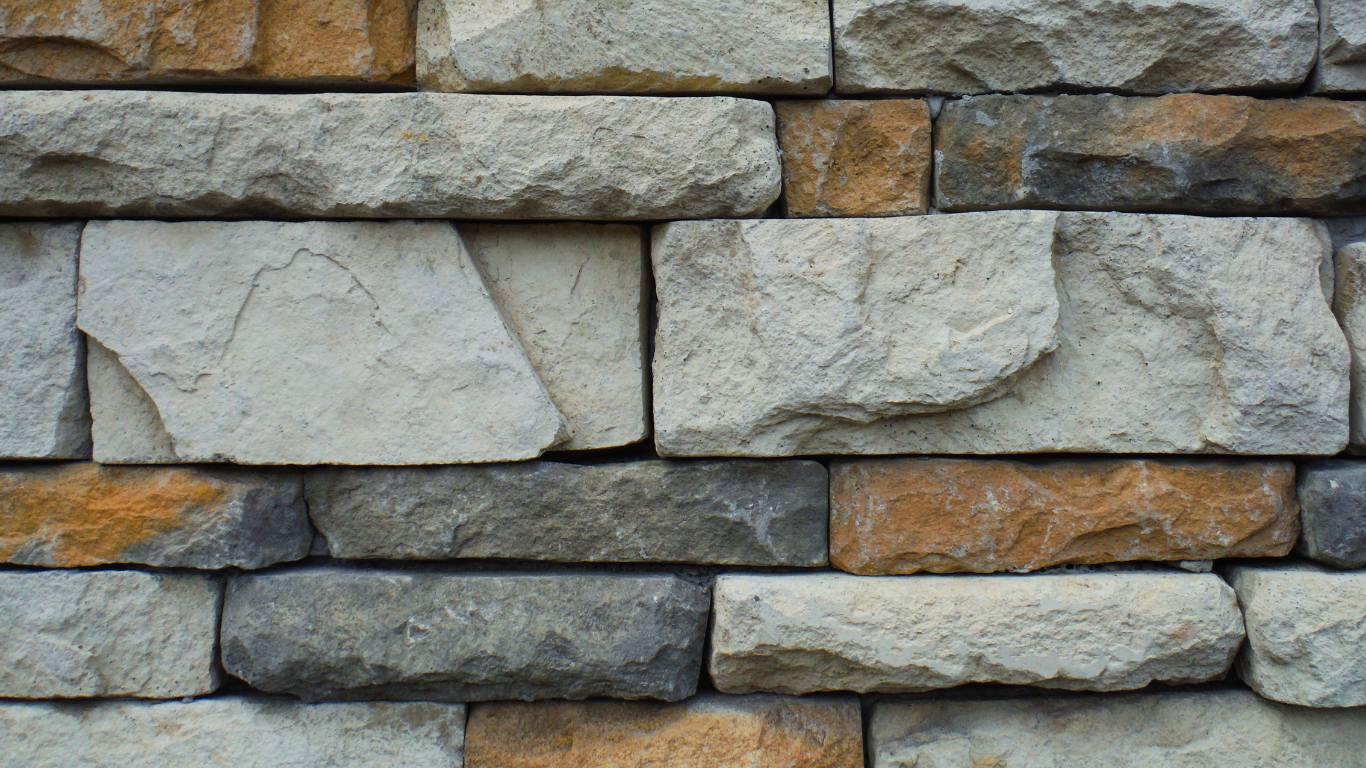
stone / natural
H — Natural quarried material, inert, non-toxic, offers aesthetic variation, color & depth, contains no VOCs, plastics, or synthetic chemicals, safe to install, appropriate for a healthy home.
C — Quarrying impacts vary and include erosion, chemical runoff & releasing toxins into groundwater, no end-of-life concerns, appropriate for a conscious home.
D — Highly durable, non-combustable, resistant to weather, wear, pests, fading, & cracking, heavy & requires proper structural substrate, long history of use, low maintenance, lifespan 80 - 100+ years.